Tattoos are far more than modern fashion statements; they are deeply personal fragments of history, culture, and individual identity etched directly into the skin. When you walk into a modern tattoo parlor, the sheer volume of artistic styles available can be completely overwhelming. From hyper-realistic portraits to delicate, fine-line minimalism, the choices are endless.
Yet, amidst the constantly shifting landscape of ink trends, one specific aesthetic remains an unshakeable cornerstone of the industry: traditional tattoo art. Also affectionately known as “Old School” or American Traditional, this iconic style is defined by its heavy black outlines, starkly limited color palettes, and instantly recognizable motifs like soaring eagles, weeping hearts, and roaring panthers.
The dilemma many tattoo enthusiasts face is deciding whether to chase a fleeting modern trend or invest in a piece of body art that will stand the test of time. Finer lines can fade, blur, and lose their definition over the decades. If you want an enduring piece of art that looks just as striking in thirty years as it does on the day you leave the shop, understanding the power of old-school techniques is your solution. This definitive guide explores the deep roots of traditional tattoo art, uncovers its most famous imagery, and gives you actionable expert advice on how to select and preserve your own timeless piece of ink.
Traditional Tattoo Art vs. Modern Styles: A Quick Glance
Before we look at the specific imagery that defines this genre, let’s look at how American traditional tattooing compares to other popular modern styles in terms of application, durability, and healing.
| Artistic Feature | Traditional (Old School) | Fine Line / Minimalist | Neo-Traditional |
|---|---|---|---|
| Line Thickness | Ultra-bold, thick black lines | Thin, delicate, subtle lines | Varied line weights |
| Color Palette | Solid primary colors (Red, Yellow, Green, Blue) | Monochromatic black and grey | Broad, illustrative, vibrant gradients |
| Aging / Durability | Exceptional; “Bold will hold” | Prone to fading and blurring | High, protected by strong structures |
| Pain Level | Higher (Thicker needle groupings) | Lower to moderate | Moderate to high |
| Healing Difficulty | Low to medium (Saturated but straightforward) | Low (Minimal skin trauma) | Medium to high (Heavy blending) |
10 Iconic Motifs in Traditional Tattoo Art
The true beauty of traditional tattoo art lies in its symbolic vocabulary. Born on the rough-and-tumble docks, military bases, and coastal entertainment hubs of the early 20th century, these designs carried profound meanings for the sailors, soldiers, and rebels who wore them.
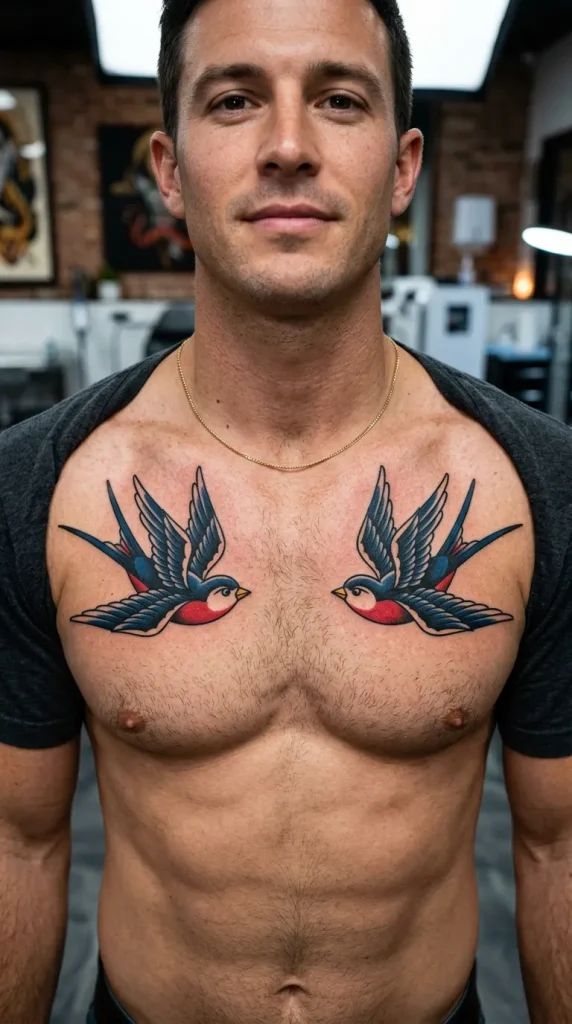
1. The Nautical Swallow
The swallow is one of the oldest and most revered symbols in maritime tattooing. Traditionally, a sailor would get one swallow upon completing 5,000 nautical miles at sea, and a second one after reaching 10,000 miles.
- Who It Suits Best: Anyone undergoing a major life journey, frequent travelers, or those seeking a symbol of safety, hope, and resilience.
- Placement & Styling Tips: Swallows look best in symmetrical pairs on the upper chest, collarbones, or matching positions on the hands. Keep the colors crisp with a vibrant red breast and deep blue wings.
- Key Benefits: Incredibly dynamic movement that complements the natural curves of the body, and a universally positive message of safe return.
2. The Anchored Sailor
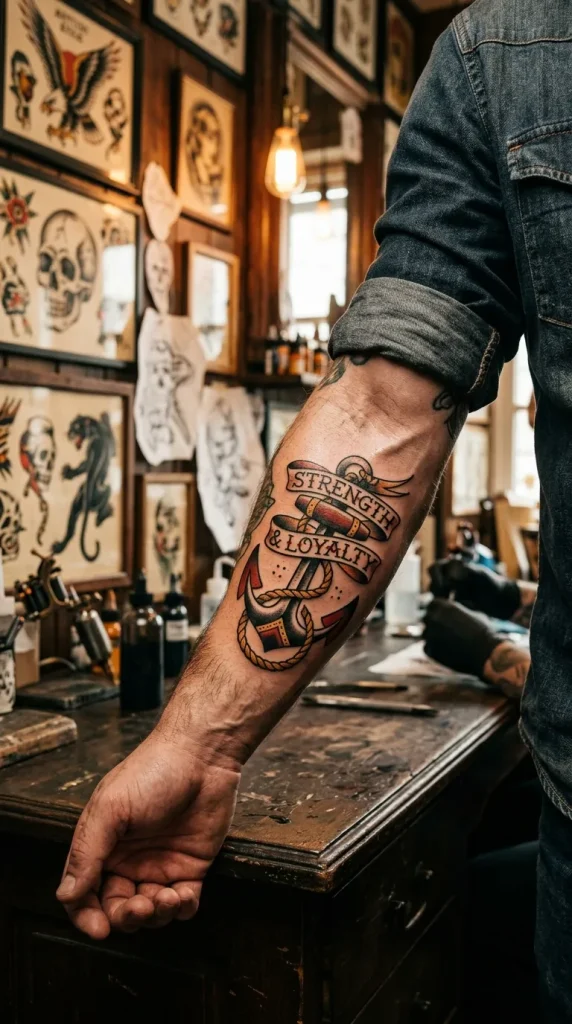
Originally used to denote a sailor who had successfully crossed the Atlantic Ocean or served in the merchant marine, the anchor represents stability, groundedness, and an unshakeable foundation.
- Who It Suits Best: Individuals who prize loyalty, family, or those who have overcome turbulent emotional storms and found their inner peace.
- Placement & Styling Tips: This vertical design fits beautifully on the forearms or calves. Wrap a traditional text banner around the center featuring a loved one’s name or a meaningful word.
- Key Benefits: Highly structural shape that fills vertical spaces on limbs cleanly without requiring massive, expensive background filler.
3. The Roaring Panther
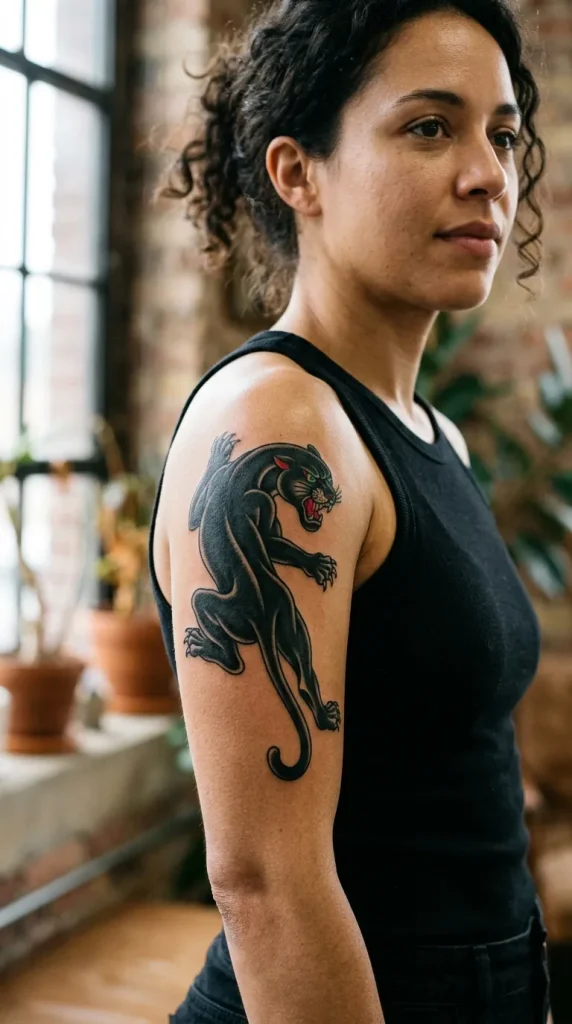
Popularized by legendary tattooists like Sailor Jerry (Norman Collins), the traditional black panther is often depicted mid-crawl, with sharp white claws, a deep red mouth, and striking green eyes.
- Who It Suits Best: Those looking for a fierce expression of power, independence, wild ferocity, and a protective spirit.
- Placement & Styling Tips: The sleek, elongated silhouette of a crawling panther makes it an exceptional choice for the outer bicep, side of the calf, or running up the ribs.
- Key Benefits: The heavy saturation of solid black ink makes the panther an unmatched option for covering up old, unwanted tattoos seamlessly.
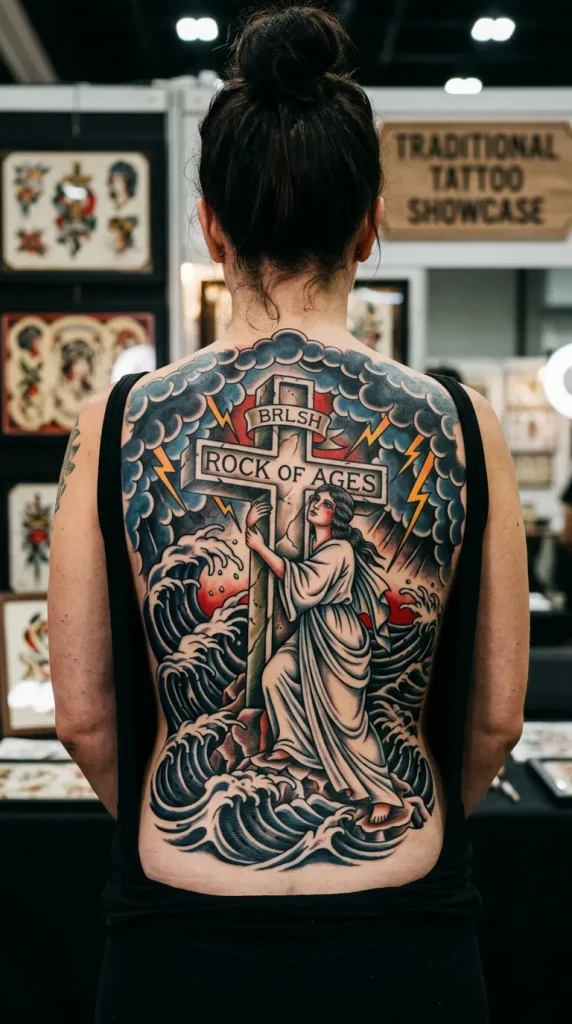
4. The Rock of Ages
A classic religious motif adapted from 19th-century stone monuments and paintings, this design features a woman clinging tightly to a large stone cross amidst crashing, stormy ocean waves.
- Who It Suits Best: Collectors looking for an epic, large-scale piece that symbolizes faith, spiritual endurance, and protection against worldly chaos.
- Placement & Styling Tips: Because of its immense detail and structural weight, this design demands a large canvas like a full backpiece or a spacious thigh panel.
- Key Benefits: A true showstopper that demonstrates high technical skill through smooth black-and-grey whip shading mixed with vivid primary color accents.
5. The Battle Royale
An ambitious design featuring an epic struggle between multiple apex predators—typically an eagle clashing with a snake, or a panther fighting a dragon. It represents the eternal balance of opposing forces and inner conflict.
- Who It Suits Best: Serious tattoo collectors who appreciate complex, high-energy compositions and historical tattoo flash.
- Placement & Styling Tips: This requires a broad, flat surface. The upper back or the chest are the perfect locations to allow the overlapping animals to wrap naturally.
- Key Benefits: Packs an incredible visual punch, utilizes the full classic color palette, and stands out as a true connoisseur’s choice in tattoo history.
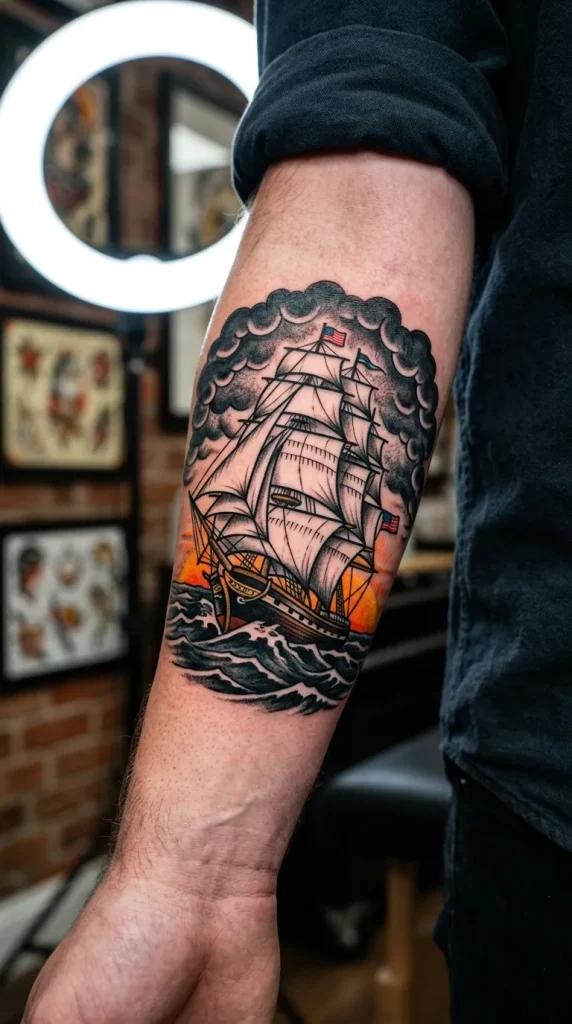
6. The Clipper Ship
A majestic, fully-rigged sailing ship tossing on rough seas symbolizes adventure, a desire for freedom, and a refusal to be tamed by life’s unpredictable currents.
- Who It Suits Best: Free spirits, entrepreneurs, and anyone who views life as an grand, open-ended voyage across deep waters.
- Placement & Styling Tips: Looks fantastic on the inner forearm or as the centerpiece of a traditional sleeve. Frame the bottom with a setting sun and stylized water splashes.
- Key Benefits: The intricate linework of the sails contrasts beautifully against heavy black cloud shading, creating massive depth and scale.
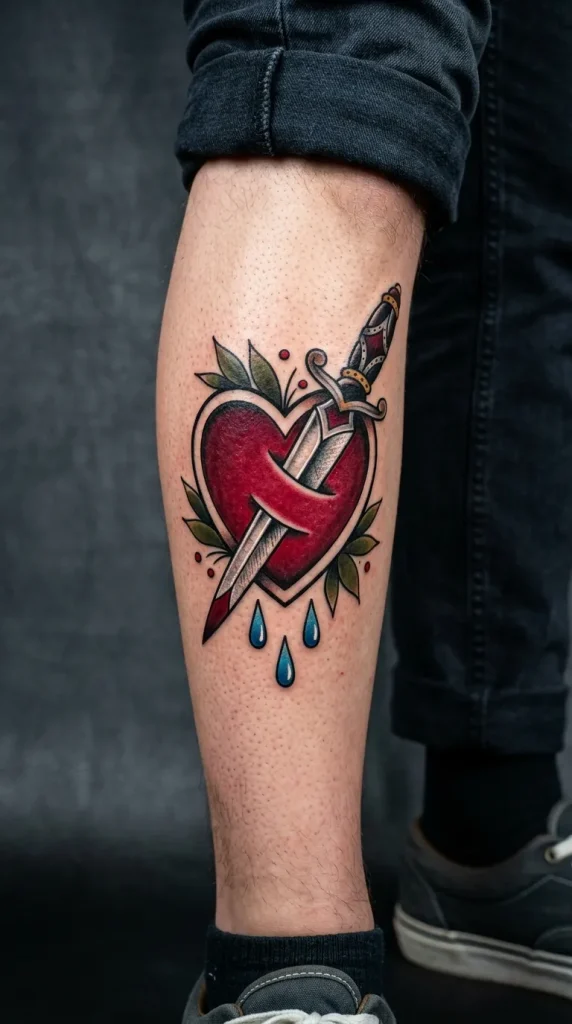
7. The Crying Heart and Dagger
A sharp dagger piercing directly through a crimson heart, often dripping with heavy tears or blood droplets, represents betrayal, heartbreak, and emotional vulnerability.
- Who It Suits Best: Romantics, poets, or anyone honoring a profound emotional loss or a lesson learned through romantic struggle.
- Placement & Styling Tips: The long, piercing shape of the dagger makes it an excellent fit for the center of the forearm, the shin, or vertically down the sternum.
- Key Benefits: High contrast between the deep reds of the heart and the cold steel metallics of the blade makes this one of the most visually striking pieces in a collection.
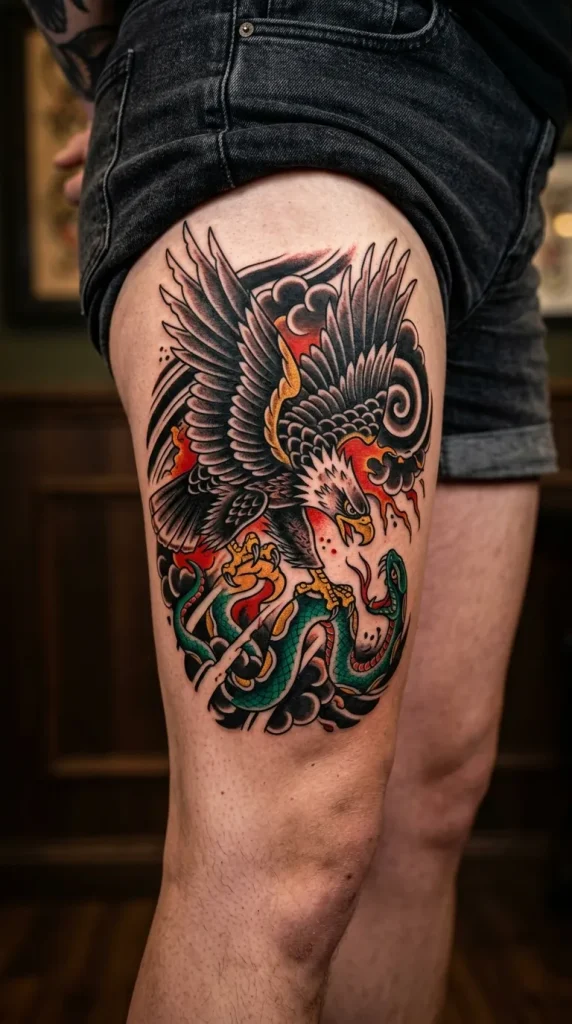
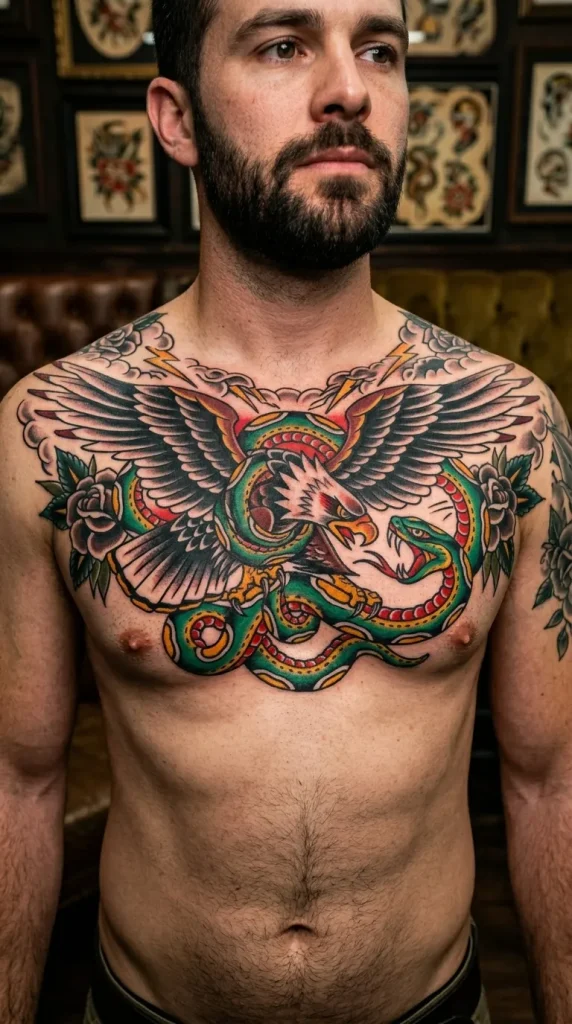
8. The Eagle and Snake
The fierce eagle swooping down to grab a writhing serpent represents the triumph of light over darkness, wisdom over low temptation, and courage over stealth.
- Who It Suits Best: Individuals celebrating a major victory over an addiction, an toxic habit, or a challenging period of personal adversity.
- Placement & Styling Tips: Perfect for an expansive chest piece, where the eagle’s wings can spread naturally across the pectoral muscles.
- Key Benefits: Incredible motion and a powerful silhouette that is instantly readable from across a room due to the heavy contrast of the feathers and scales.
9. The Sacred Heart
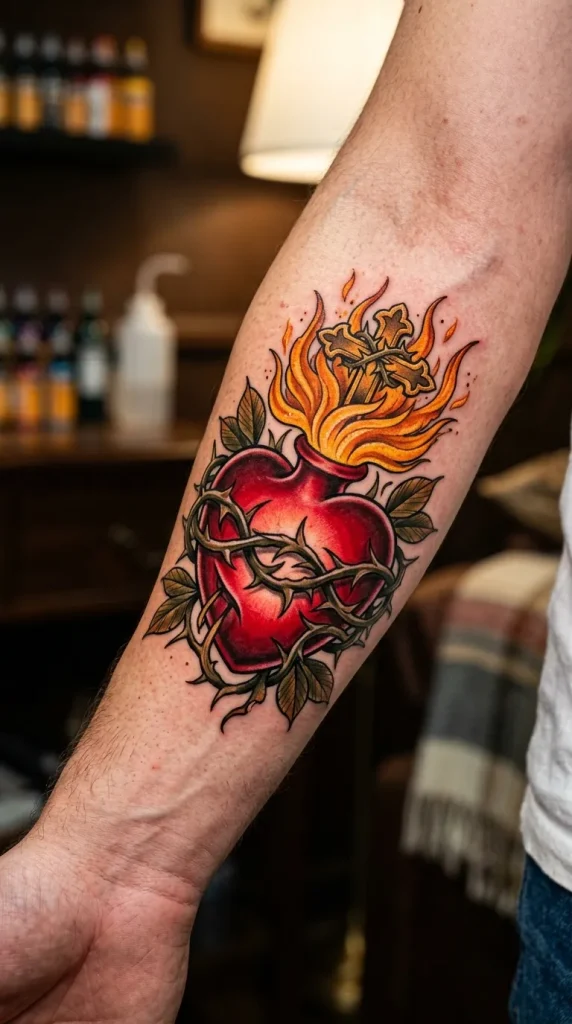
An ornate heart topped with flickering flames, wrapped in thorns, or radiating bright beams of light. It represents divine love, deep passion, and a burning inner devotion.
- Who It Suits Best: Those who wear their hearts on their sleeves, artists, and people driven by deep empathy and internal passion.
- Placement & Styling Tips: This compact, rounded design is perfect for filling awkward gaps on a sleeve, or placed directly over the physical heart on the chest.
- Key Benefits: High color saturation capabilities, especially with bright yellows for the flames and rich crimsons for the body of the heart.
10. The Lady Head
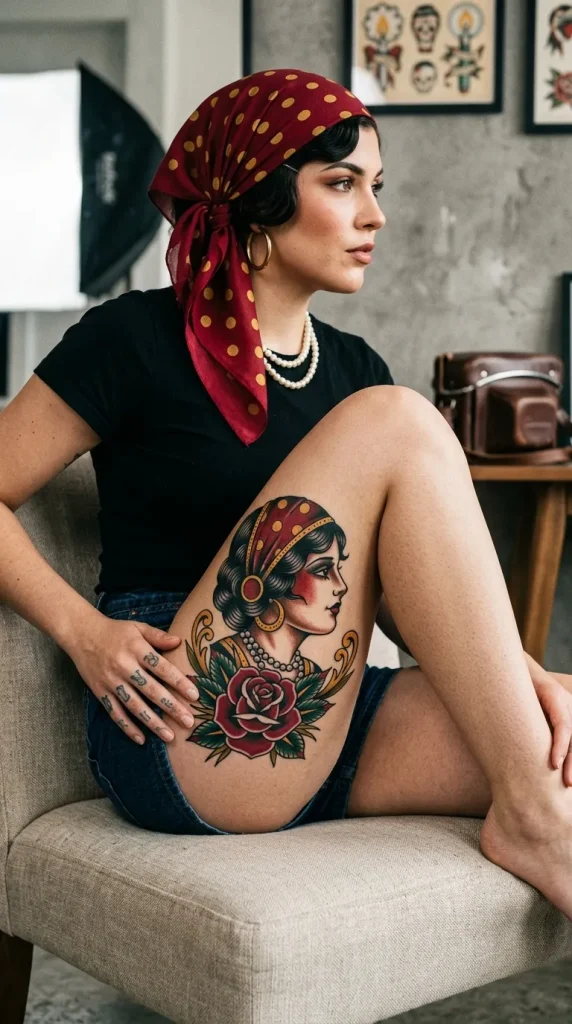
A beautifully stylized portrait of a woman, often adorned with a gypsy headscarf, a native headdress, or framed by a blooming red rose. Historically, it kept sailors company during lonely months at sea and symbolized idealized beauty.
- Who It Suits Best: Lovers of vintage Americana, classic illustration, and those wanting to celebrate feminine strength and mystique.
- Placement & Styling Tips: Give the lady distinct features with smooth facial shading. It sits beautifully on the outer bicep or the front of the thigh.
- Key Benefits: Highly customizable features allow you to work with your artist to make the portrait unique while keeping the timeless vintage aesthetic intact.
Pro Tips for Choosing Flash and Finding the Right Artist
If you are ready to take the plunge into traditional tattoo art, keep these industry insider tips in mind to ensure you get a masterpiece:
💡 The Golden Rules of Getting Traditional Ink
- Understand the Rule of Thirds: Traditional tattooing relies on a specific balance: 1/3 solid black shading, 1/3 vibrant color saturation, and 1/3 negative skin space. Make sure your artist’s portfolio reflects this balance so the design has room to breathe as it ages.
- Look for Clean Line Work: Look closely at an artist’s healed work. The lines should be crisp, uniform in thickness, and entirely free of shaky waves or blurry “blowouts” where the needle went too deep.
- Don’t Overcomplicate the Flash: Traditional art is built on simplicity and readability. Avoid trying to cram twenty small details into a single design. Trust the classic flash—it is simple for a reason.
- Commit to Proper Aftercare: Wash your fresh ink gently with a fragrance-free antibacterial soap, pat dry with a clean paper towel, and apply a thin layer of a specialty tattoo ointment. Avoid soaking in pools, hot tubs, or exposing the fresh tattoo to direct sunlight for at least three weeks.
Common Mistakes to Avoid with Traditional Tattoos
To ensure your artistic investment looks incredible for decades, watch out for these common missteps:
- Shrinking the Design Too Small: Because traditional art utilizes very thick black outlines, a design that is made too small will eventually bleed together over time. If your artist tells you a piece needs to be bigger to preserve the detail, trust their expertise.
- Using Non-Traditional Color Gradients: Traditional art relies on flat, hard-saturated blocks of color rather than smooth, airbrushed transitions. Avoid asking for pastel or neon shades; they will ruin the historical authenticity of the style.
- Picking the Wrong Placement for Shapes: Rounded designs (like a lady head or a rose) belong on rounded muscle bellies, while long, vertical designs (like daggers) belong on long limbs. Forcing a design into a space that doesn’t naturally fit its shape will distort the image when you move.
Frequently Asked Questions (FAQs)
1. Why do traditional tattoos hold up better over time?
Traditional tattoos hold up incredibly well because of the industry mantra: “Bold will hold.” The thick black ink outlines act as a permanent framework. Even when the internal colors fade slightly over decades, the unmistakable silhouette remains sharp and readable from a distance.
2. What is the difference between Traditional and Neo-Traditional tattoos?
Traditional tattoos use flat primary colors, very thick, uniform line weights, and classic imagery from the early 20th century. Neo-Traditional tattoos keep the concept of bold outlines but introduce modern elements like illustrative line weights, highly detailed realism, modern color palettes (jewel tones, pastels), and contemporary fantasy imagery.
3. Do traditional tattoos hurt more than other styles?
The pain level can feel slightly more intense during the linework phase. This is because traditional artists use larger needle groupings (like a 9 or 11 Round Liner) to achieve those signature thick lines, requiring slightly more pressure to saturate the skin uniformly compared to a single fine-line needle.
4. How long does a traditional tattoo take to heal completely?
The surface layer of the skin typically heals within 2 to 3 weeks, after which the peeling stops. However, the deeper layers of skin take up to 2 to 3 months to fully recover and settle. Consistent moisturizing with a scent-free lotion during this phase is crucial for long-term vibrancy.
In Conclusion: Ready to Claim Your Piece of History?
Traditional tattoo art is far more than a vintage trend—it is an enduring testament to the grit, soul, and creative spirit of early modern tattooing. From the romantic symbolism of a pierced heart to the fierce power of a crawling black panther, these designs offer an unmatched combination of readability, cultural power, and lifetime durability.
When you choose a traditional piece, you aren’t just getting inked; you are stepping into a rich lineage of historical self-expression that refuses to fade away quietly.
Ready to make your mark? Spend some time browsing classic flash sheets, locate an artist who specializes in bold line work and heavy saturation, and book a consultation to create a piece of art that you will wear proudly for the rest of your days!